
You finish a full mock, see 412 out of 720, feel bad or good, and open the next one. That wastes most of what a mock can tell you. To analyse a NEET mock test properly, spend 30 minutes right after it on five jobs. Find where the marks went. Sort every miss by cause. Rank your chapters. Check your timing. Pick three things to fix. This post gives you that routine, in order.
The time budget: marks lost 5 minutes, sorting 10, chapters 5, timing 5, plan 5. Redoing the wrong questions comes after, within 48 hours.
Key Takeaways
- A wrong answer in NEET costs 5 marks against a full-marks paper: the +4 you didn't earn and the −1 deducted. A blank costs 4.
- Start with marks lost, not marks scored. Split the loss into wrong answers and blanks.
- Sort every missed question into one of four causes: didn't know, slipped, ran out of time, guessed.
- Rank chapters by marks lost, worst first. Fix three chapters before the next mock, not thirty.
- Redo the questions you got wrong within 48 hours. Reading the solution once is not enough.
What should you check first when you analyse a NEET mock test?
Check where the marks were lost, before anything else. Your score is only the end of the story. The first five minutes go on one question: of the 720 marks, how many did wrong answers cost, and how many did blanks cost?
NEET (UG) 2026 gave +4 for a right answer, −1 for a wrong one and 0 for a blank. The source is the NTA 2026 information bulletin (Chapter 4). NTA has not published the 2027 bulletin, so treat the same scheme as the working assumption. Our NEET 2027 exam pattern post tracks what is confirmed.
Here is a made-up example, not real student data. A student attempts 150 of 180 questions, gets 108 right and 42 wrong, and leaves 30 blank.
| Item | Count | Marks | Lost against 720 |
|---|---|---|---|
| Right answers | 108 | +432 | 0 |
| Wrong answers | 42 | −42 | 210 (42 × 5) |
| Blanks | 30 | 0 | 120 (30 × 4) |
| Score | 390 | 330 |
The score is 390. But the 330 marks lost split into 210 from wrong answers and 120 from blanks. Wrong answers cost almost twice as much, so that is where to dig first.
How do you sort the questions you got wrong?
Give every wrong or blank question one label. Four labels cover almost everything, and each one needs a different fix.
- Didn't know. You had no idea, or the concept was shaky. Fix: study the chapter, then practise it.
- Knew it, slipped. You knew the concept but misread the question, flipped a sign or marked the wrong option. Fix: slow down on the last read, and check the unit or the "NOT" in the stem.
- Ran out of time. You skipped it or rushed it. Fix: a time plan, not more study.
- Guessed. You picked an option without a reason. Fix: decide your guessing rule before the next mock.
Do this on paper or in a notes app, one line per question: number, chapter, label. For 72 misses, expect about ten minutes. Don't re-solve yet. You are only sorting.
Then count. If 20 of your 42 wrong answers are "knew it, slipped", you don't have a syllabus problem. You have an exam-habit problem, and extra chapters won't fix it. If 25 are "didn't know", the opposite is true.
Be honest with the labels. "Slipped" is the comfortable label, because it means you didn't really need to study. If you got a question wrong and still can't solve it cleanly now, it is "didn't know".
Which chapters should you fix first?
Fix the chapters that cost you the most marks, worst first. Count marks lost per chapter (wrong × 5 + blank × 4), sort from highest to lowest and take the top three.
A chapter with three wrong answers has lost 15 marks. A chapter with five blanks has lost 20. The second needs more attention, even though it has no wrong answers at all.
Check the subject split as well. NEET (UG) 2026 set 45 Physics, 45 Chemistry and 90 Biology questions, per the same bulletin. If Biology is half the paper but only a fifth of your lost marks, you are doing fine there. If Physics is a quarter of the paper and half of your lost marks, that is your next month.
Look at the NEET PYQ chapter counts too. A chapter that costs you marks and is also asked often goes to the top of the list. But don't skip a low-count chapter that keeps costing you marks.
Reading a chapter report that ranks by accuracy
Cleartest is our product, so a short note. Its chapter analysis lists chapters weakest first by accuracy, across all your tests. Blanks don't count towards accuracy. So add your blanks × 4 to each chapter's wrong × 5 before you pick your three.
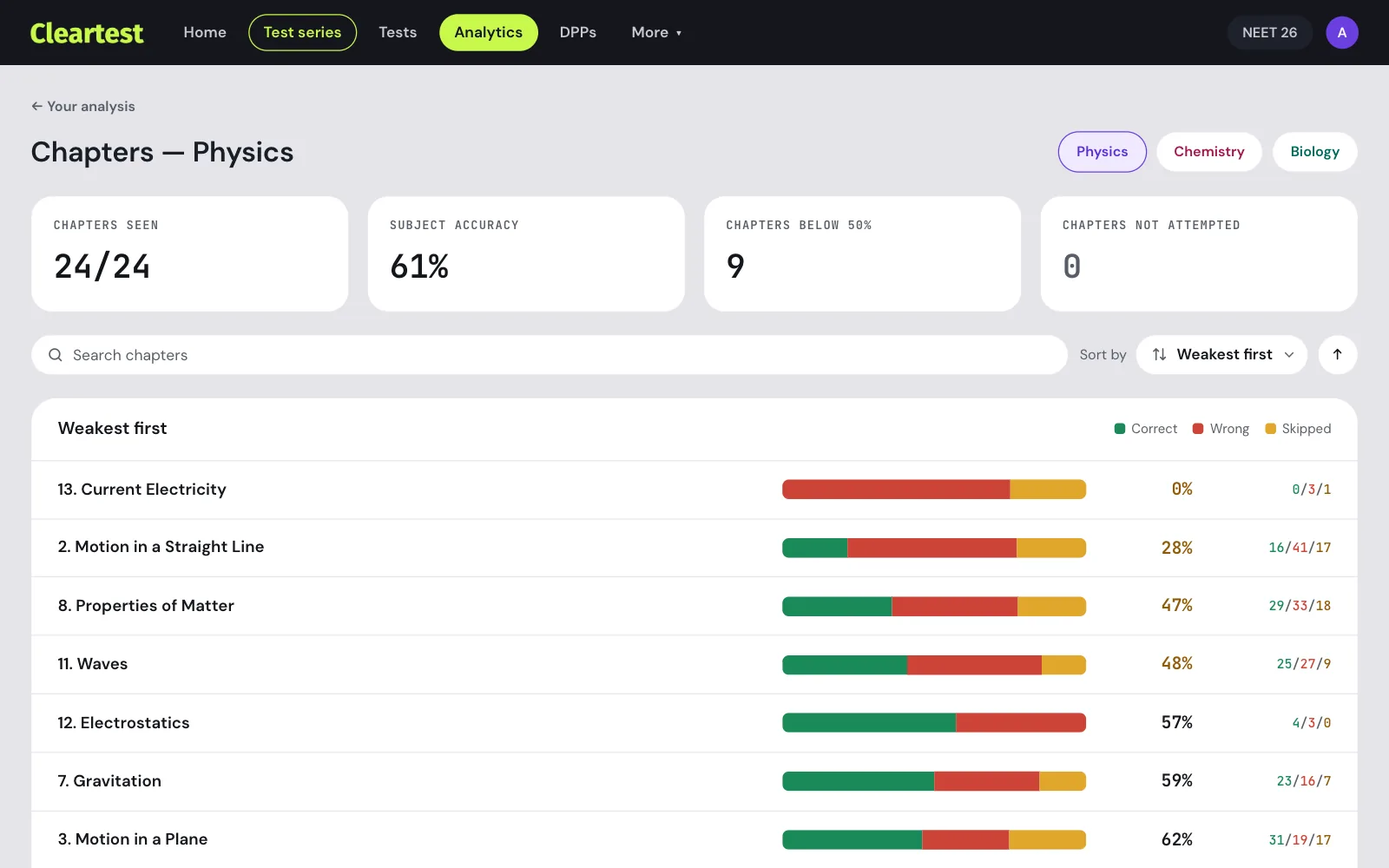
Here is why that matters, with made-up numbers. Chapter A: 4 attempted, 2 wrong. That is 50% accuracy and 10 marks lost. Chapter B: 6 attempted, 1 wrong, and 4 blanks. That is 83% accuracy but 21 marks lost (5 + 16).
An accuracy list puts A first. Marks lost puts B first. For one mock, trust marks lost. Across many mocks, accuracy shows which chapters stay weak. Use both. The table takes five minutes on paper.
How do you review your timing?
Look at when you lost marks, not only how many. A mock has 180 questions and 180 minutes, so the average is one minute a question. If your result page doesn't show time per question, log it yourself in the next mock. Every 30 minutes, and once more with 20 minutes left, write the clock time and the question you're on. Also write down the number of any question that takes more than three minutes. Then check three things.
- How many questions were still untouched with 20 minutes left? If it is more than 15, your order of attempt is the issue.
- Did your wrong answers rise in the last hour? Count them in the third hour against the first. A rise points to tiredness or rushing.
- Which of those questions ate the most time? One stubborn Physics numerical at six minutes costs you five easy Biology questions.
On a computer-based test, timing is its own skill, because you see one question at a time. NTA's JEE (Main) screen has a Question Paper icon that opens the full paper (JEE (Main) 2026 bulletin, Appendix VIII, item 21a), but finding the questions you know still takes clicks, not a glance. NEET is reported to move to computer-based testing from 2027. A Medical Dialogues report of 3 November 2026 says 2027 may let candidates choose screen or paper.
What should you do in the last five minutes of the review?
Write down three fixes, with a date for each. Skip this step and the review changes nothing about your next mock.
- Three chapters. The top three from your marks-lost ranking. Put them in next week's plan, ahead of anything new.
- One habit. The biggest label from your sort. If it is "knew it, slipped", the habit might be "re-read the last line of every question before saving".
- One timing rule. For example: "If a numerical isn't moving by two minutes, mark it and leave."
Then redo the wrong questions. Do it within 48 hours, closed book, before you look at the solution again. If you can now solve a question without help, it is learned. If not, it goes back on the list.
Keep one log for all your mocks: date, score, marks lost to wrong answers, marks lost to blanks, top three chapters. After four or five mocks, the trend tells you more than any single score. Your total may go up and down, but marks lost to wrong answers should fall.
A note for parents: the useful question after a mock is not "what was your score?" Ask "where did you lose the marks, and what are you changing?" A student who can answer that is learning from the mock.
Where can you practise this routine?
Take a full mock on a screen, then run the routine the same day. Start with our free NEET CBT mock test. It has a question palette, mark for review, a live timer and +4/−1 marking, with a solution for every question afterwards.
For a full run of exam-style tests, try our AIIMS Toppers Test Series. It has 24 online tests, prepared and verified by NEET qualifiers selected into AIIMS, with chapter analysis after each one.
Read next
NEET
NEET Previous Year Questions: A 12-Week Chapter Plan
NEET previous year questions, chapter-wise: a 12-week plan with the order, a daily pace of about 29 questions and a way to log every miss by chapter.
NEET
NEET Negative Marking: What One Wrong Answer Really Costs
NEET negative marking costs 5 marks per wrong answer, not 1. See the maths, a guess-or-skip table and when attempting a doubtful question pays.
NEET
Do NEET Questions Repeat? How to Use NEET PYQ Better
Do NEET questions repeat? Learn what 'repeated' means and how to use NEET PYQ by wording, concept and topic, with counts from our own question bank.