
Question Paper Format for Coaching Institutes: A Template
A question paper format for coaching institutes: what goes in the header, instructions, sections and answer key, so every NEET or JEE paper looks the same.
A question paper format is the part of a test nobody plans and everybody notices. Students notice when the marking scheme is missing. Parents notice when the page has no institute name. Your own staff notice when two teachers set two differently laid-out papers for the same batch.
Here is a format you can fix once and reuse for every NEET and JEE paper. It covers four parts: the header, the instructions, the sections and the answer key. Use it as a checklist, then save it as a template.
Key Takeaways
- Fix the format once and reuse it. Only the date, test name, batch and questions should change from paper to paper.
- The header answers who, what, when and how long. The instructions answer how it is marked.
- Mirror the NEET pattern in your sections: 45 Physics, 45 Chemistry and 90 Biology, +4 for correct and −1 for wrong.
- Keep the question paper, the answer key and the solutions as three separate files.
- Run a five-point check before every print, and check the key last.
What should the header of a question paper contain?
The header should tell a student and a parent, at a glance, which institute, test and batch this is. It should also give the date, the time allowed, the total marks and the number of questions. Anything else belongs in the instructions.
A header that works for a coaching institute:
- Institute name and logo, at the top of page one. On a printed set this is what a parent sees first.
- Test name, such as "NEET Full Mock 07" or "Class 12 Physics Part Test 3". Use one naming pattern so papers sort in order in a folder.
- Batch, for example "Dropper Batch A". Several batches may sit similar tests in the same week.
- Date and time allowed.
- Maximum marks and number of questions.
- A line for name and roll number, if students write on the paper itself.
Leave out the teacher's name, the venue and long slogans. They crowd the page and change often. If you set a paper for more than one batch, keep the header the same and change only the batch line.
What instructions belong on a coaching institute question paper?
Put the instructions on page one, under the header, in five to eight short lines. They should cover the marking, what students may carry, and how to mark answers. Students read them only once, so keep them brief.
For a NEET-pattern paper, the marking line should match the real exam. NTA's NEET (UG) 2026 Information Bulletin (Chapter 4) sets the subject-wise counts: 45 Physics, 45 Chemistry and 90 Biology. It also sets the marking: +4 for a correct answer and −1 for an incorrect one. Check the current bulletin before each term, because the pattern has changed before.
A sample set of instructions:
- The paper has 180 questions and 720 marks. Time allowed: as printed above.
- Each question has four options. Exactly one is correct.
- Correct answer: +4. Wrong answer: −1. Unattempted: 0.
- Mark answers on the answer sheet only. Rough work goes on the sheet provided.
- No calculators or mobile phones. (Delete this line for a take-home DPP.)
Say the −1 plainly in your instructions. A student who sees it printed on every paper learns to treat a guess as a cost, which is the habit the real exam rewards.
How should you divide a paper into sections?
Divide it by subject, in the same order every time, and label each section with its question count and marks. For NEET, that means three or four sections. For JEE, follow the pattern of the paper you are mirroring.
The NEET 2026 bulletin gives 45 Physics, 45 Chemistry and 90 Biology questions, with Biology listed as one block of 90. Many institutes print it as two sections, Botany and Zoology, 45 each, so two teachers can set and check their halves separately. A section table that works:
| Section | Questions | Marks | Marking |
|---|---|---|---|
| Physics | 45 | 180 | +4 / −1 |
| Chemistry | 45 | 180 | +4 / −1 |
| Biology | 90 | 360 | +4 / −1 |
For a chapter test or DPP the sections change, but the rule doesn't. Each one gets a heading with its count and marks. Questions are numbered continuously from 1 to the end, so "Q112" means one thing to everybody. If you are still working out the split, see our post on how to make a NEET mock test paper. It plans subject split, chapter coverage and difficulty before you pick a question.
How should each question be laid out?
Number it, give it the same space as every other question, and keep the four options in a fixed pattern. Consistency matters more than style here. A student under time pressure should never have to work out where the options start.
- Number and stem on one line where possible, with the options below it.
- Options labelled (1) to (4), or (A) to (D) if that is what your answer sheet says. Pick one and keep it across the whole institute.
- Numerical-answer questions get a boxed space for the answer instead of options, in the same place on every page.
- Diagrams placed beside or under the question that uses them, never on the next page.
- No question split across a page break. Move it to the next page, even if that leaves white space.
- Space for rough work on a printed paper, or a blank page at the end.
Assertion-reason and statement questions need the same discipline. Print the instruction once above the first one and repeat the four standard options under each. Our post on picking assertion-reason questions for NEET tests covers how many to use.
What should the answer key look like?
An answer key should be one page, separate from the paper. It needs the question number against the correct option and very little else: a small header and the section totals. A teacher should be able to check an answer sheet against it in a few seconds.
Format it the way you will use it:
- A grid of question number and option, in blocks of 10 or 15 so the eye doesn't lose its place.
- Each section's question count and maximum marks at the bottom, so every teacher totals a sheet the same way.
- Test name and date in a small header, so a key never ends up against the wrong paper.
Keep the key out of the same file as the paper. A single PDF that has both will, sooner or later, reach a student before the test does.
Why keep the solutions in a separate file?
Because the key and the solutions do different jobs. The key is for fast checking. The solutions are for the student's review after the test, and they run to many pages. Mixing them makes the key slow to use and the solutions easy to leak.
A solution file works best when each solution carries the question number, the correct option and a short worked reason. A student reviewing a test then reads only the questions they missed.
Three files, then: the paper, the key and the solutions. Release the paper at the start of the test and the key when it ends. Release the solutions a day or two later, once students have rechecked their own answers.
How do you keep the question paper format the same on every paper?
Save it as a template and change only what differs. Typing a header and instructions fresh for each paper is where errors come from. It is also where parents start asking why this paper looks different.
Cleartest is our product, so weigh this accordingly. In the question paper generator you can save your logo, heading and instructions as a template and pick questions by chapter, topic and difficulty. You can then export the question paper, the answer key and the solutions as separate PDFs. The logo, saved templates and solution PDFs are on our paid plans; the free plan gives you the paper and its answer key. The paper below is a real generated one with a sample coaching's logo, showing test data. Its header leaves out the batch and the date; in your own template, put them in the sub-heading line.
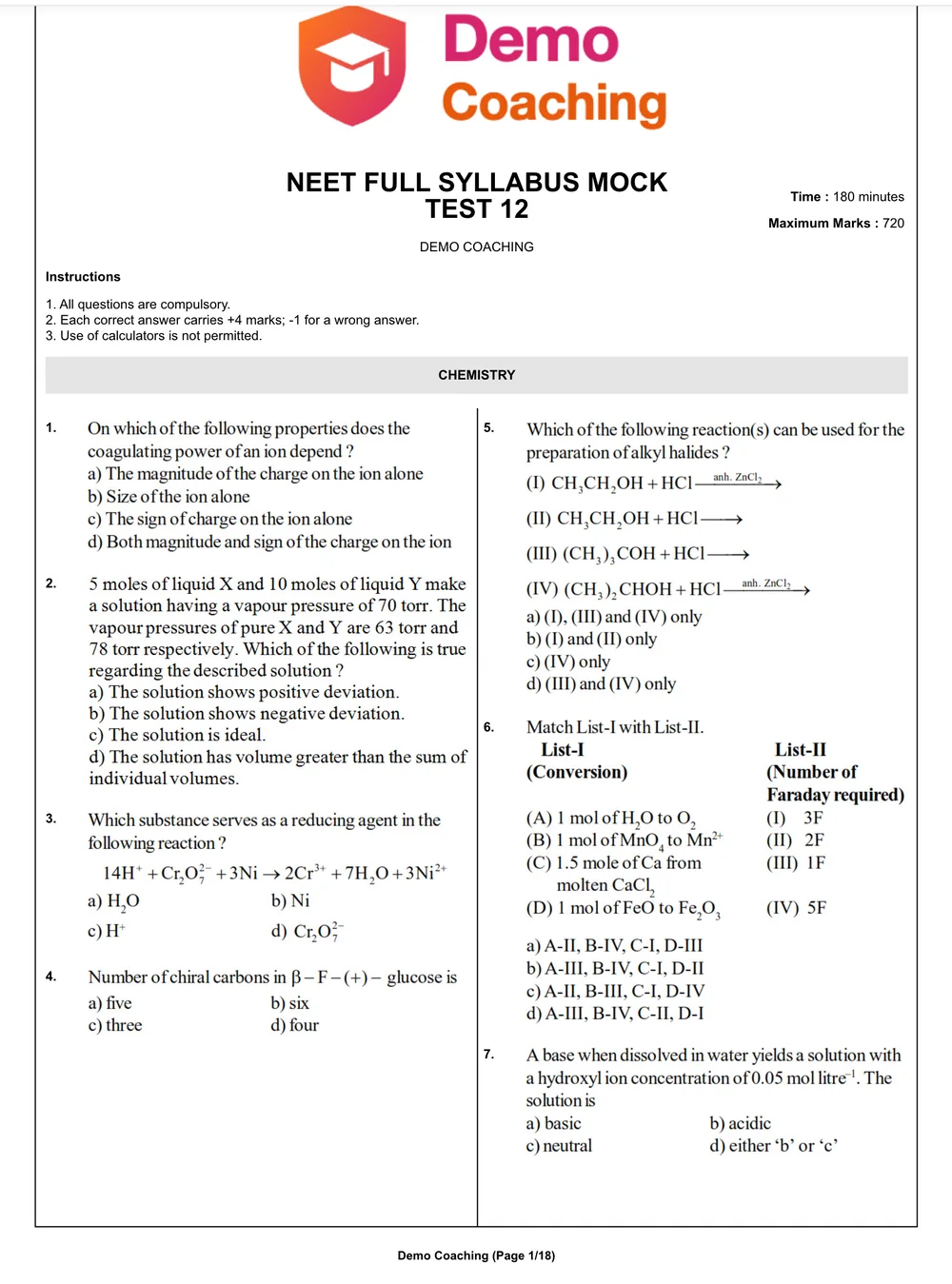
If you set papers by hand, the same idea works in a word processor. Build one blank paper with the header, instructions and section headings, lock it, and copy it for every test.
What should you check before you print?
Run the same short check on every paper, whoever set it. It takes two minutes and catches most of the mistakes that reach a classroom.
- Are the test name, batch and date correct?
- Do the section counts and total marks add up to what the instructions say?
- Are questions numbered continuously, with no gaps or repeats?
- Does any question or diagram split across a page?
- Does the answer key match the final question order, after any last-minute swap?
Check item 5 last, after every edit. Swapping one question at the end is a common reason a key and a paper stop agreeing.
What should you do next?
Take your last printed paper and mark it against this post: header, instructions, sections, key. Fix the gaps, then save the result as the format every teacher in the institute uses from the next test.
If you would rather not rebuild it each time, start free or book a demo on our page for teachers and institutes. Build your next paper and its answer key free, and add your logo and saved instructions on a paid plan.
Read next
Question papers
How to Make a Question Paper Quickly: Where 6 Hours Go
How to make a question paper quickly: the seven steps that eat about 6 hours on a 180-question paper by hand, and how to time and cut each one.
Question papers
Assertion Reason Questions in NEET: How to Pick Them
Assertion reason questions in NEET and statement-based questions: how to count them in past papers and mirror that mix in your weekly NEET tests.
Question papers
NEET Question Bank for Institutes: Books, PDFs or Digital?
Choosing a NEET question bank for your institute? Compare books, PDFs and a tagged digital bank on tags, solutions, reuse tracking and PYQ filters.